
Building for Data Center Power Demand: Why Energy Infrastructure Is Becoming a Manufacturing Challenge
Posted on: October 7, 2026
Weldall and Scherrer team members celebrate the opening of Weldall’s new 50,000-square-foot high-bay manufacturing expansion.
Data centers may be associated with software, servers and computing power, but none of them operate without a much older piece of infrastructure: electricity.
As data center development accelerates across the United States, the conversation is increasingly moving beyond what happens inside the building. Utilities, energy companies, equipment manufacturers and infrastructure developers are being asked to supply substantially more power, sometimes at a scale that requires entirely new generation, transmission and distribution infrastructure.
That makes growing data center power demand more than a technology story. It is becoming a manufacturing story.
Data Centers Are Changing the Scale of Power Demand
The issue is not whether the growth of artificial intelligence, cloud computing or large-scale data processing is good or bad. From a manufacturing perspective, the important question is much more practical:
What has to be built to supply the electricity these facilities require?
The U.S. Energy Information Administration expects electricity consumption to reach record levels in both 2026 and 2027, driven in part by data center development and increased manufacturing activity. EIA currently forecasts U.S. electricity sales of approximately 4,135 billion kilowatthours in 2026 and 4,211 billion kilowatthours in 2027.
Individual projects show just how quickly those numbers translate into physical infrastructure.
In Louisiana, Entergy’s plans associated with Meta’s hyperscale data center include seven new combined-cycle power plants totaling more than 5,200 megawatts, approximately 240 miles of new 500-kV transmission lines and battery storage at three locations.
In Wyoming, Black Hills recently announced plans to invest $1.8 billion in new company-owned generation to support a planned Google data center in Cheyenne. The broader resource plan associated with the project reaches approximately 2.7 gigawatts.
Those projects are different in design, geography and energy strategy. But they illustrate the same point.
A very large data center does not simply plug into an outlet.
More Electricity Means More Physical Infrastructure
Before electricity reaches a data center, there is an entire physical system behind it.
Power has to be generated. It has to move across transmission systems. Voltage has to be transformed. Substations have to distribute it. Cooling, backup systems and other supporting equipment have to operate reliably around it.
Every step involves physical equipment.
And physical equipment has to be manufactured.
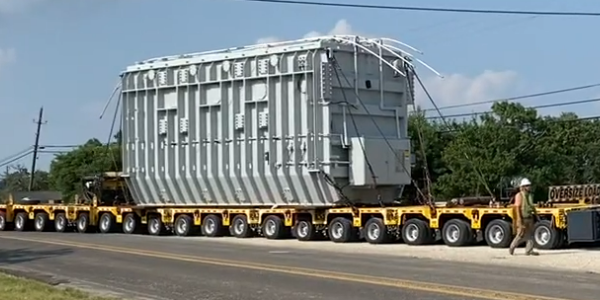
For the energy industry, growing demand can translate into additional generation equipment, utility-scale transformers, transmission infrastructure, structural assemblies, equipment frames, ductwork, support structures and other large fabricated components.
The scale of this infrastructure is one reason the manufacturing conversation matters.
A component can look straightforward on a drawing until it becomes 20 feet long, weighs tens of thousands of pounds, requires thick plate to be formed, includes extensive welding and still has critical machined surfaces that have to land exactly where engineering intended.
At that point, size is only part of the challenge.
The real challenge is maintaining control as the project gets bigger.
Weldall has worked directly with power-generation facilities and major industry suppliers on applications including large utility-scale electrical transformers, conveyance ductwork and other heavy-plate fabrications.
That experience matters because the infrastructure supporting today’s growing electrical demand is not entirely new. What is changing is the amount of it that may need to be built, upgraded and delivered.
More Power Can Become a Manufacturing Capacity Problem
Heavy energy equipment asks a lot from a manufacturing partner.
The supplier may need to source and trace material, cut and form heavy plate, control weld distortion, complete critical welding procedures, machine the assembly after fabrication, verify dimensional requirements and move an oversized component safely from one operation to the next.
A shop may be capable of welding a structure but lack the machining capacity to finish it.
Another may be able to machine the component but cannot fabricate or handle something at the required scale.
A third may have enough floor space but lack the inspection systems, material controls or documentation requirements the customer expects.
Those gaps matter because every additional handoff introduces another schedule, another transportation step and another opportunity for information or dimensional control to get lost between suppliers.
This is one reason Weldall has continued investing in the ability to perform large-scale fabrication and precision machining within the same manufacturing operation.
Weldall describes this as its “machine-all” advantage. Large weldments can move from fabrication into in-house precision CNC machining without requiring the customer to coordinate separate welding and machining suppliers. That can reduce lead time while giving the manufacturing team greater control over quality and dimensional consistency.
For energy equipment manufacturers facing increasing demand, that kind of manufacturing depth can become just as important as raw production capacity.
Where Heavy Fabrication Fits Into Data Center Power Infrastructure
Weldall is not building data centers.
That distinction is important.
The opportunity for a heavy manufacturer like Weldall exists further upstream, where power-generation and electrical-equipment manufacturers need large fabricated and machined components capable of becoming part of much larger systems.
These projects can involve heavy plate, large weldments, machined fabrications, equipment structures and other oversized assemblies where strength alone is not enough.
Precision still matters.
A 50,000-pound weldment does not become less dimensionally critical because it is large. If anything, the manufacturing challenge increases. Welding introduces heat. Heat creates movement. Thick materials behave differently than smaller components. Machining allowances have to account for the fabrication process. Lifting and repositioning have to be considered before the first weld is made.
The entire process has to work together.
That is why equipment capacity is only useful when it is backed by manufacturing discipline.
Weldall’s forming capabilities include CNC press brakes up to 2,000 tons for large and heavy plate work. Its large machining equipment includes machines with working capacities reaching 100,000 pounds, while its SNK gantry machining center is designed for oversized structural components requiring precision at scale.
Material handling is part of that equation as well. Weldall’s facilities are configured to support fabricated assemblies weighing more than 400,000 pounds, with heavy-lift capability exceeding 200 tons.
Those numbers are useful, but they are not the point by themselves.
The point is what those capabilities allow a customer to manufacture.
What Energy Equipment Buyers Should Look for in a Fabrication Partner
When power infrastructure projects move into large, complex or quality-critical assemblies, the supplier conversation should go deeper than asking whether a shop can weld the part.
A better set of questions is:
Can they form it?
Heavy plate can quickly narrow the list of capable suppliers, particularly when the component requires long bends, thick material or geometry that has to remain controlled through subsequent operations.
Can they weld it correctly and control distortion?
Large weldments require planning. Weld sequence, heat input, fixturing and material behavior all affect the finished assembly.
Can they machine it after welding?
Many fabricated structures require precision bores, mounting surfaces, interface points or other features after the welding is complete. Moving a large weldment to another supplier for machining can add time, cost and risk.
Can they inspect it?
The bigger and more critical the assembly becomes, the less useful “it looks right” becomes as a quality standard. Dimensional verification, nondestructive examination and documented inspection processes may all become part of the requirement.
Can they trace the material and document the process?
Weldall maintains material traceability from incoming raw material through manufacturing, supported by barcoding and quality-control systems designed for demanding applications.
And can they physically handle it?
This is easy to overlook during sourcing. A component still has to be lifted, rotated, transported between work centers and positioned for welding, machining and inspection.
On large projects, material handling is not an afterthought.
It is part of the manufacturing process.
Building for the Power Demand Ahead
Data centers are one of several forces increasing electricity demand across the United States. Manufacturing growth, electrification, grid modernization and other industrial development are contributing as well.
Whatever the source of that demand, the infrastructure response will be physical.
More generation requires equipment.
More transmission requires equipment.
More transformer capacity requires equipment.
And as those systems grow in size and complexity, equipment manufacturers will need suppliers that can combine heavy fabrication capacity with precision, inspection and manufacturing control.
That is where Weldall Manufacturing fits.
For decades, Weldall has supported power generation and other demanding industries with large weldments, heavy plate fabrication, precision machining and quality-critical manufacturing. The goal is not simply to make something big.
It is to make something big and still get the details right.
If your next energy or power-infrastructure project requires a large, complex or precision-machined fabrication, bring Weldall into the conversation before manufacturing capacity becomes the bottleneck.